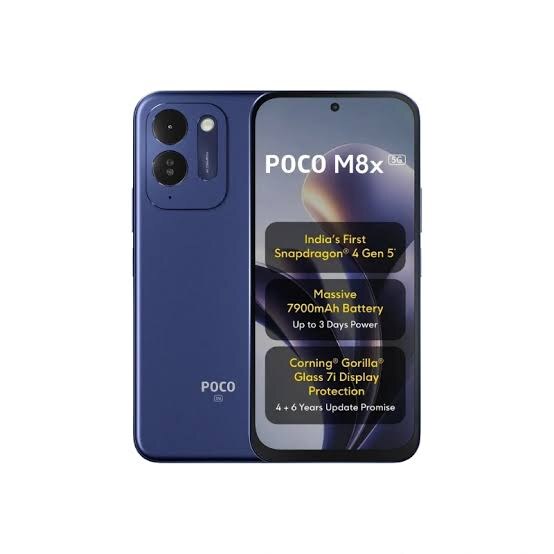
The Xiaomi Poco M8x is a budget 5G smartphone built around one very obvious idea: give users a huge battery, a large 120Hz display and modern connectivity without pushing the price too high. Released in August 2026, the Poco M8x combines the Snapdragon 4 Gen 5 chipset with a 7,900mAh battery, 45W wired charging and a 6.9-inch display.
It is also one of those phones where the specification sheet needs a little context. The 120Hz refresh rate sounds impressive, and the 5G support makes it feel modern, but the display uses a 720 x 1600 HD+ resolution rather than Full HD+. The camera setup is also fairly simple, with a 50MP main camera supported by an auxiliary lens.
For Nigerian buyers, that makes the Poco M8x particularly interesting for people who value battery endurance, a large screen and everyday reliability more than premium cameras or a high-resolution display.
Poco M8x Price in Nigeria
The Xiaomi Poco M8x is currently listed in Nigeria at around ₦350,000. This price can change depending on the storage/RAM version, seller, warranty, import costs and exchange-rate movements.
The phone launched in India with the 4GB RAM + 128GB storage version starting at ₹18,999, while the 6GB + 128GB model was introduced at ₹22,999. This gives some context for its position in the budget market, although Nigerian retail prices naturally differ because of importation, taxes, distribution and currency fluctuations.
Anyone buying the Poco M8x in Nigeria should therefore compare the actual price of the 4GB and 6GB versions rather than assuming that every listing represents the same configuration. The dedicated microSD card slot is useful too, particularly for buyers who want more storage without paying for a more expensive internal-storage option.
Design and Build
The Poco M8x has a large body measuring 170.1 x 78.4 x 8.8 mm and weighs 232 grams. That is not a lightweight phone, but the size makes sense once the enormous 7,900mAh battery is taken into account.
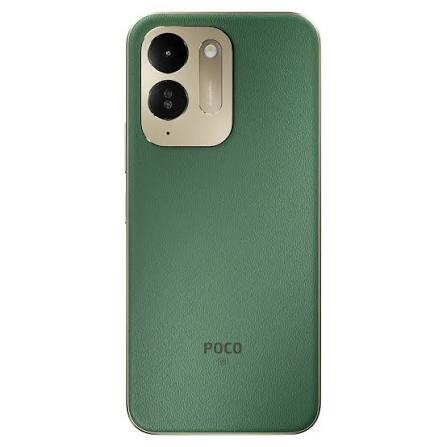
The front uses Gorilla Glass 7i, while the frame is plastic. Depending on the colour and version, the rear can use either a plastic finish or a silicone-polymer eco-leather-style material. Leather Green, Black and Blue are the listed colours, giving the phone a little more visual variety than some basic budget models.
There is also an IP64 rating for protection against dust and water splashes. That does not mean the phone should be deliberately submerged, but it provides useful protection against everyday exposure to dust and accidental splashes.
The side-mounted fingerprint scanner is another practical choice. It is easy to reach on a phone this large and sits alongside the usual accelerometer, proximity sensor and compass.
6.9-Inch 120Hz Display: Smooth, But Only HD+
The Poco M8x comes with a 6.9-inch IPS LCD running at up to 120Hz. The screen resolution is 720 x 1600 pixels, giving it a pixel density of roughly 254 ppi.
The large size is useful for watching YouTube, browsing websites, reading documents, using WhatsApp and navigating social media. The 120Hz refresh rate also makes scrolling and supported animations look noticeably smoother than a conventional 60Hz panel.
However, the HD+ resolution is one of the compromises buyers need to understand. On a 6.9-inch screen, 720p does not produce the same level of sharpness as a Full HD+ display. Text and fine details can look softer when viewed closely.
The display can reach around 825 nits under high-brightness conditions, which should help when using the phone outdoors. Gorilla Glass 7i also adds protection against everyday scratches and impacts. The combination makes the screen practical, but buyers looking for a very sharp multimedia display should keep the resolution limitation in mind.
Snapdragon 4 Gen 5 Performance
Powering the Poco M8x is Qualcomm’s Snapdragon 4 Gen 5, built on a 4nm process. It has two Cortex-A78 performance cores running at up to 2.4GHz and six Cortex-A55 efficiency cores clocked at up to 2.0GHz, paired with an Adreno 613 GPU.
This is an entry-level to lower-midrange chipset rather than a gaming-focused processor. It should be well suited to everyday tasks such as WhatsApp, Facebook, Instagram, YouTube, web browsing, online classes and general multitasking.
The 4nm manufacturing process is also helpful for efficiency. Combined with the relatively modest HD+ display, it should not need to work as hard as a more powerful chipset driving a high-resolution panel.
Gaming is possible, but expectations should remain realistic. Games such as PUBG Mobile, Call of Duty Mobile and Free Fire should be playable with sensible graphics settings, but this is not the sort of phone designed for maximum graphics quality or consistently high frame rates in demanding titles. The Snapdragon 4 Gen 5 is more about balanced everyday performance and efficiency than raw gaming power.
RAM, Storage and microSD Support
The Poco M8x comes with 128GB of UFS 2.2 storage and either 4GB or 6GB of RAM. The dedicated microSDXC slot is one of the more useful features for budget buyers.
The 6GB version should be the preferable configuration for people who regularly switch between several applications. It gives the system more breathing room when multitasking, particularly as apps become larger and more demanding over time.
The 4GB model is better suited to lighter users. For WhatsApp, calls, browsing, social media, music and video streaming, it can still handle the basics, but the 6GB version offers more flexibility for longer-term use.
UFS 2.2 storage is also a reasonable choice at this price level. It is not flagship-grade storage, but it provides a faster experience than older, slower storage standards commonly found on inexpensive phones.
50MP Main Camera
Photography is not the biggest selling point of the Poco M8x, although the 50MP main camera should be capable of producing respectable results in good lighting.
The rear setup consists of a 50MP f/1.8 wide camera with PDAF, accompanied by an auxiliary lens. LED flash and HDR are also available, while video recording reaches 1080p at 30fps.
In daylight, the main sensor should be capable of producing photographs with enough detail for social media, messaging and normal personal use. PDAF should also help with focusing on subjects.
The limitations become more obvious at night. This is still a budget camera system, and there is no sophisticated telephoto or ultrawide camera to provide additional shooting flexibility. The auxiliary lens should therefore not be treated as equivalent to having a second high-quality camera.
For video, 1080p at 30fps is the ceiling listed for the rear camera. That is adequate for everyday clips, but users looking for 4K recording will need to consider a more expensive device.
8MP Selfie Camera
On the front is an 8MP f/2.0 wide selfie camera with a 1/4.0-inch sensor and 1.12µm pixels.
It should handle selfies, video calls and social-media content reasonably well in good lighting. HDR is also available to help balance brighter and darker parts of an image.
Once again, the specification shows where Poco has kept costs under control. An 8MP front camera is functional rather than exceptional, and low-light selfies are unlikely to match what more expensive phones can produce.
Video recording from the front camera reaches 1080p at 30fps, which is sufficient for calls and basic content creation.
7,900mAh Battery Is the Main Attraction
The Poco M8x’s biggest hardware advantage is its 7,900mAh battery. That is considerably larger than the battery found in many conventional smartphones.
The combination of a large battery, an efficient 4nm processor and a relatively low-resolution LCD should make endurance one of the phone’s strongest characteristics. Independent testing has also found that the M8x can comfortably stretch into a second day under heavy everyday use, although actual results will vary with network conditions, brightness, gaming and usage patterns.
For someone who spends long hours away from a charger, that matters. A user can spend hours on WhatsApp, YouTube, social media, music and other normal applications without constantly watching the battery percentage.
Charging is rated at 45W wired, with support for PD. The phone also supports 22.5W reverse wired charging, allowing the large battery to supply power to compatible accessories or another phone.
The 45W charging speed is useful because a battery this large would otherwise take considerably longer to replenish. It is not the fastest charging system in the smartphone market, but it is a sensible match for a 7,900mAh battery.
Android 16 and HyperOS
The Poco M8x ships with Android 16 and Xiaomi’s HyperOS 3 software. Xiaomi has also stated that the phone will receive up to four major Android/OS updates and six years of security updates, which is notable for a phone in this price category.
HyperOS brings the familiar Xiaomi interface and ecosystem features, while the hardware also supports modern functions such as 5G connectivity.
The long software-support promise is particularly important for someone planning to keep the phone for several years. However, the actual experience will still depend on how quickly updates are delivered in the user’s market and on the phone’s performance as future software becomes more demanding.
Connectivity and Audio Features
The Poco M8x supports GSM, HSPA, LTE and 5G, making it suitable for users who want a budget phone that can move to faster mobile networks where 5G coverage is available.
It also supports Wi-Fi, Bluetooth 5.1, GPS, GLONASS, Galileo and BDS. NFC is not included, so users who specifically depend on NFC-based functions should take that into account before buying.
One feature that has become less common on newer smartphones is still present here: the 3.5mm headphone jack. The Poco M8x also has stereo speakers and supports 24-bit/192kHz Hi-Res audio.
There is a USB Type-C 2.0 port with OTG support. The phone also includes FM radio, which adds another practical feature for users who still rely on traditional radio listening.
Poco M8x for PUBG, Call of Duty and Everyday Gaming
The Snapdragon 4 Gen 5 is capable of handling casual and moderately demanding games, but the Poco M8x should not be confused with a dedicated gaming phone.
Free Fire and similar lightweight titles should be relatively comfortable. PUBG Mobile and Call of Duty Mobile should also be playable at appropriate settings, although demanding graphics presets will put more pressure on the chipset and GPU.
The 120Hz display can make compatible games and the interface feel smoother, but the refresh rate does not automatically mean that every game will run at 120fps. Game optimization, graphics settings and the Snapdragon 4 Gen 5’s capabilities determine the actual frame rate.
The large battery is arguably more useful to gamers than the 120Hz specification itself. Long gaming sessions can consume substantial power, and the 7,900mAh capacity gives the Poco M8x a much larger reserve than many competing budget phones.
Poco M8x Pros and Cons
Pros
- Huge 7,900mAh battery
- 45W wired charging
- 22.5W reverse wired charging
- 6.9-inch 120Hz display
- 5G connectivity
- Snapdragon 4 Gen 5 4nm processor
- Dedicated microSD card slot
- Stereo speakers
- 3.5mm headphone jack
- Gorilla Glass 7i
- IP64 dust and splash resistance
- Android 16
- Up to four major OS updates and six years of security updates
Cons
- 720p resolution on a very large 6.9-inch display
- 232g weight makes it fairly heavy
- Basic camera system
- Only 1080p video recording
- No NFC
- USB Type-C 2.0
- 4GB RAM version may feel limited for heavy multitasking
Poco M8x vs Poco M8
The Poco M8x is not simply a larger version of the regular Poco M8. The two phones target somewhat different priorities.
The Poco M8 uses a smaller 6.77-inch display with a higher 1080p-class resolution and Snapdragon 6 Gen 3 hardware, while the M8x moves toward a much larger 6.9-inch HD+ panel and Snapdragon 4 Gen 5. The M8x counters with its much larger 7,900mAh battery.
That means the M8 makes more sense for someone who cares about sharper visuals and stronger processing performance, while the M8x’s hardware is built more around endurance and a very large display.
Poco M8x vs Poco M8 Power
The Poco M8 Power is another interesting alternative because it also focuses heavily on battery life. Current Nigerian listings place the M8 Power around ₦437,500, compared with about ₦350,000 for the M8x.
The M8 Power offers an 8,000mAh battery and a higher-resolution 7.0-inch display, while the M8x uses a 7,900mAh battery and 6.9-inch 720p display.
The price difference means buyers should look carefully at the exact features they need. The M8x is positioned as the more affordable option, while the M8 Power provides some upgrades for buyers willing to spend more.
Who Should Buy the Poco M8x?
The Poco M8x is particularly suitable for users who put battery life ahead of almost everything else.
Students, commuters, social-media users, delivery workers and people who regularly spend long periods away from a wall charger could benefit from the 7,900mAh battery. The 5G support also gives the phone some future relevance as network coverage expands.
It is also a sensible choice for people who still want a headphone jack, FM radio and expandable storage. Those features are increasingly difficult to find together on modern smartphones.
Who Should Avoid the Poco M8x?
Buyers who care strongly about display sharpness should look elsewhere. A 6.9-inch 720p screen is usable, but it cannot match the clarity of a good Full HD+ or AMOLED panel.
The same applies to photography. The 50MP main camera is useful for everyday shots, but the Poco M8x is not designed for people who want advanced zoom, ultrawide photography, high-end night photography or 4K video.
Heavy gamers should also consider phones with stronger chipsets. The Snapdragon 4 Gen 5 is designed more for efficient everyday performance than high-end gaming.
Frequently Asked Questions
What is the Poco M8x price in Nigeria?
The Poco M8x is currently listed in Nigeria at around ₦350,000, although the actual selling price can vary by RAM configuration, seller, warranty and market conditions.
Does the Poco M8x support 5G?
Yes. The Poco M8x supports GSM, HSPA, LTE and 5G connectivity.
How big is the Poco M8x battery?
The Poco M8x has a 7,900mAh battery with 45W wired charging and 22.5W reverse wired charging.
Does the Poco M8x have a headphone jack?
Yes. The phone has a traditional 3.5mm headphone jack and stereo speakers.
Does the Poco M8x support a memory card?
Yes. It has a dedicated microSDXC slot, allowing users to expand storage beyond the built-in 128GB.
Is the Poco M8x good for gaming?
It can handle everyday and moderately demanding games, but it is not a high-end gaming phone. The Snapdragon 4 Gen 5 is better suited to balanced performance and efficiency than maximum graphics settings.
Final Verdict
The Xiaomi Poco M8x is built around endurance rather than premium specifications. Its 7,900mAh battery is the standout feature, while 45W charging, reverse charging, 5G, a 120Hz display, expandable storage and stereo speakers give it a useful collection of features for a budget phone.
Its biggest compromise is the 6.9-inch HD+ LCD. The screen is large and smooth, but the 720 x 1600 resolution is noticeably less ambitious than what some competitors offer. The 50MP camera is also better viewed as a competent everyday shooter than a photography-focused system.
At around ₦350,000 in Nigeria, the Poco M8x is therefore positioned as a practical phone for users who value battery endurance, a large screen and useful everyday features. Its strongest selling point is not one spectacular specification, but the way the large battery, efficient Snapdragon 4 Gen 5 processor and 45W charging work together to make frequent charging less of a concern.